Diskusikan sesuai dengan materi hari ini
Kelompok 3
Anggota Kelompok :
1. Anggun Sari 1914121005
2. Ulivia Alfina Zahra 1914121011
Judul Scanning Electron Microscopy Of The Interaction Between Cryptococcus magnus And Colletotrichum gloeosporioides On Papaya Fruit
Jurnal : Pesquisa Agropecuaria Brasileira
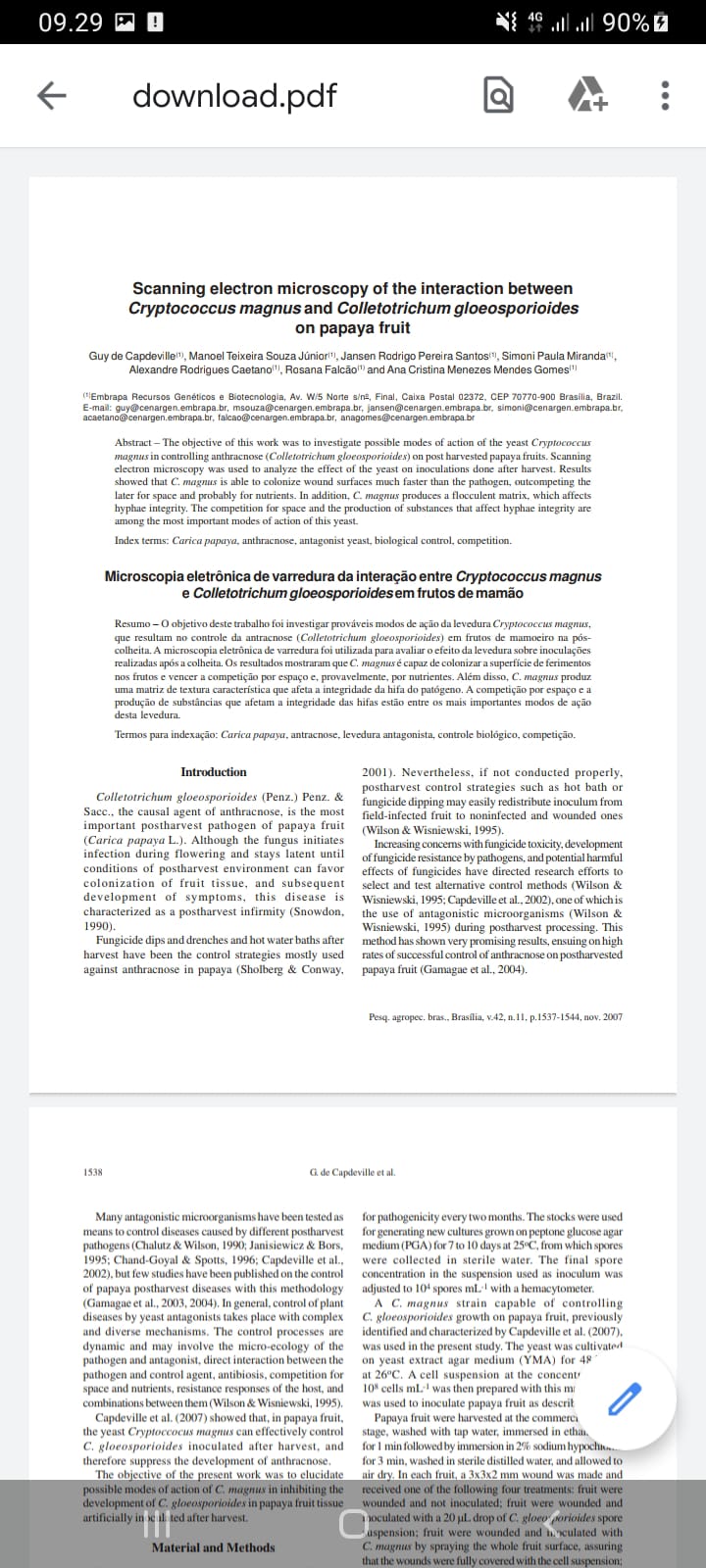
Abstract: The objective of this work was to investigate possible modes of action of the yeast Cryptococcus magnus in controlling anthracnose (Colletotrichum gloeosporioides) on post harvested papaya fruits. Scanning electron microscopy was used to analyze the effect of the yeast on inoculations done after harvest. Results showed that C. magnus is able to colonize wound surfaces much faster than the pathogen, outcompeting the later for space and probably for nutrients. In addition, C. magnus produces a flocculent matrix, which affects hyphae integrity. The competition for space and the production of substances that affect hyphae integrity are among the most important modes of action of this yeast.
Anggota Kelompok :
1. Anggun Sari 1914121005
2. Ulivia Alfina Zahra 1914121011
Judul Scanning Electron Microscopy Of The Interaction Between Cryptococcus magnus And Colletotrichum gloeosporioides On Papaya Fruit
Jurnal : Pesquisa Agropecuaria Brasileira
Abstract: The objective of this work was to investigate possible modes of action of the yeast Cryptococcus magnus in controlling anthracnose (Colletotrichum gloeosporioides) on post harvested papaya fruits. Scanning electron microscopy was used to analyze the effect of the yeast on inoculations done after harvest. Results showed that C. magnus is able to colonize wound surfaces much faster than the pathogen, outcompeting the later for space and probably for nutrients. In addition, C. magnus produces a flocculent matrix, which affects hyphae integrity. The competition for space and the production of substances that affect hyphae integrity are among the most important modes of action of this yeast.
Anggota Kelompok 2
Agfharinda Azwa 1914121003
Widia Putri Rahayu 1914121004
Aldhi Apriand.S 1914121040
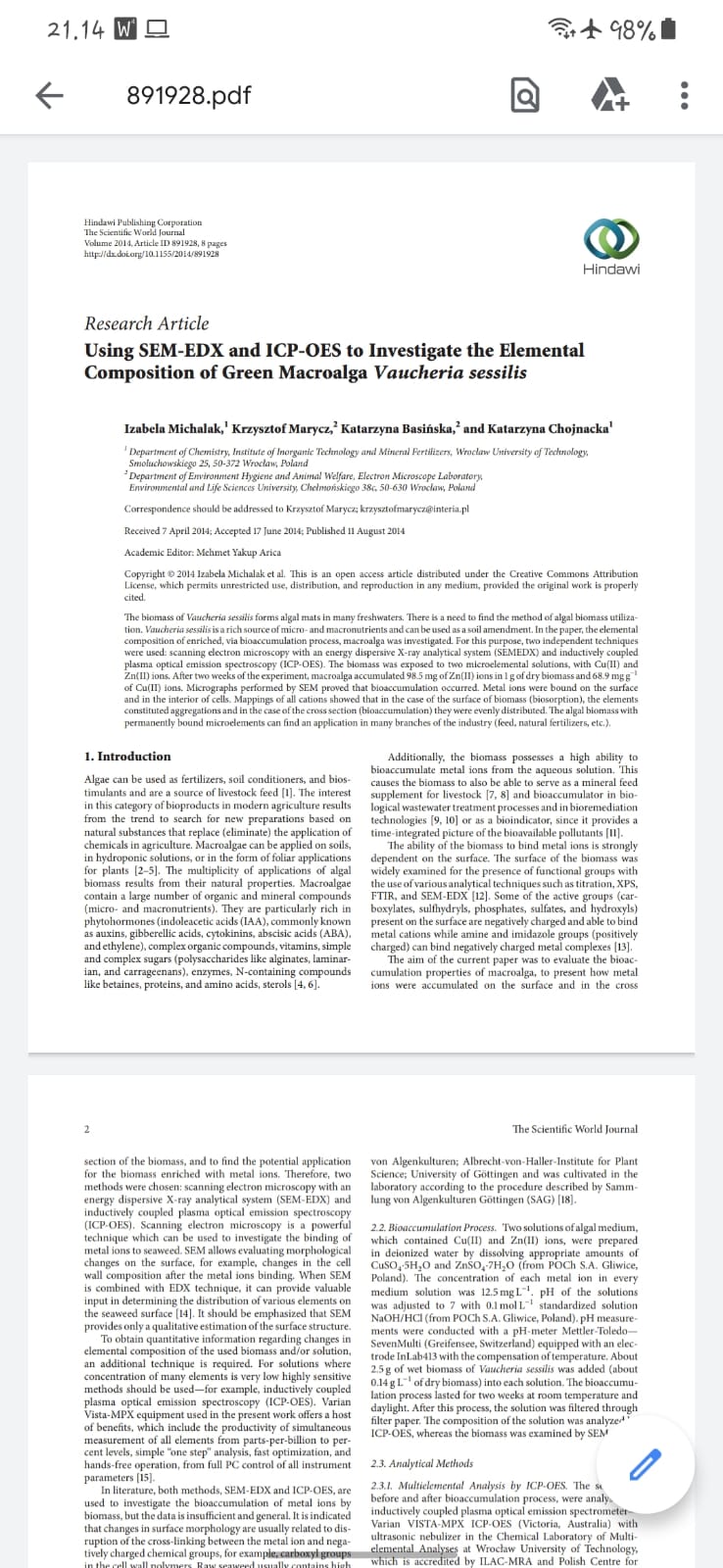
The biomass of Vaucheria sessilis forms algal mats in many freshwaters. There is a need to find the method of algal biomass utilization.Vaucheria sessilisis a rich source of micro- and macronutrients and can be used as a soil amendment. In the paper, the elemental composition of enriched, via bioaccumulation process, macroalga was investigated. For this purpose, two independent techniques were used: scanning electron microscopy with an energy dispersive X-ray analytical system (SEMEDX) and inductively coupled plasma optical emission spectroscopy (ICP-OES). The biomass was exposed to two microelemental solutions, with Cu(II) and Zn(II) ions. After two weeks of the experiment, macroalga accumulated 98.5 mg of Zn(II) ions in 1 g of dry biomass and 68.9 mg g−1 of Cu(II) ions. Micrographs performed by SEM proved that bioaccumulation occurred. Metal ions were bound on the surface and in the interior of cells. Mappings of all cations showed that in the case of the surface of biomass (biosorption), the elements constituted aggregations and in the case of the cross section (bioaccumulation) they were evenly distributed. The algal biomass with
permanently bound microelements can find an application in many branches of the industry (feed, natural fertilizers, etc.).
Agfharinda Azwa 1914121003
Widia Putri Rahayu 1914121004
Aldhi Apriand.S 1914121040
The biomass of Vaucheria sessilis forms algal mats in many freshwaters. There is a need to find the method of algal biomass utilization.Vaucheria sessilisis a rich source of micro- and macronutrients and can be used as a soil amendment. In the paper, the elemental composition of enriched, via bioaccumulation process, macroalga was investigated. For this purpose, two independent techniques were used: scanning electron microscopy with an energy dispersive X-ray analytical system (SEMEDX) and inductively coupled plasma optical emission spectroscopy (ICP-OES). The biomass was exposed to two microelemental solutions, with Cu(II) and Zn(II) ions. After two weeks of the experiment, macroalga accumulated 98.5 mg of Zn(II) ions in 1 g of dry biomass and 68.9 mg g−1 of Cu(II) ions. Micrographs performed by SEM proved that bioaccumulation occurred. Metal ions were bound on the surface and in the interior of cells. Mappings of all cations showed that in the case of the surface of biomass (biosorption), the elements constituted aggregations and in the case of the cross section (bioaccumulation) they were evenly distributed. The algal biomass with
permanently bound microelements can find an application in many branches of the industry (feed, natural fertilizers, etc.).