
Kumpulkan jurnnal terindeks scopus mengenai GCMS (Gas Chromatografy Mass Spectrometry)
Kelompok 3
Anggota Kelompok :
1. Anggun Sari 1914121005
2. Ulivia Alfina Zahra 1914121011
Judul Early Detection And Classification Of Pathogenic Fungal Disease In Post-Harvest Strawberry Fruit By Electronic Nose And Gas Chromatography-Mass Spectrometry
Jurnal : Food Research International
Abstract:
Strawberry fruit decay caused by fungal infection usually results in considerable losses during post-harvest storage; thus, discerning the decay and infection type in the early stage is necessary and helpful for reducing the losses. In this study, three common pathogenic fungi belonging to Botrytis sp., Penicillium sp. and Rhizopus sp. were individually inoculated into ripe strawberry fruits; non-inoculated fruits were used as controls. The strawberry fruits were stored at 5 ± 1 °C for 10 days. During storage, inoculated fruits began rotting on day 2, while control fruits began rotting on day 4. The volatile compounds emitted by the fruits were analysed by an electronic nose (E-nose) and gas chromatography–mass spectrometry (GC–MS). Principal component analysis (PCA) showed a clear discrimination in decay on day 0, day 2 and day 4 and the infection type on day 2 after fungal inoculation based on 5 selected sensors of E-nose. The discrimination accuracy of the fungal infection type of strawberry fruits for the four groups reached 96.6% by using multilayer perceptron neural network model. GC–MS results of the four strawberry fruit groups on day 2 identified several key characteristic volatile compounds for each infection treatment, compared with the control. Therefore, E-nose was able to realise the early diagnosis of fungal disease, in addition to an accurate classification of the pathogenic fungal type in the fruits during post-harvest storage.
Anggota Kelompok :
1. Anggun Sari 1914121005
2. Ulivia Alfina Zahra 1914121011
Judul Early Detection And Classification Of Pathogenic Fungal Disease In Post-Harvest Strawberry Fruit By Electronic Nose And Gas Chromatography-Mass Spectrometry
Jurnal : Food Research International
Abstract:
Strawberry fruit decay caused by fungal infection usually results in considerable losses during post-harvest storage; thus, discerning the decay and infection type in the early stage is necessary and helpful for reducing the losses. In this study, three common pathogenic fungi belonging to Botrytis sp., Penicillium sp. and Rhizopus sp. were individually inoculated into ripe strawberry fruits; non-inoculated fruits were used as controls. The strawberry fruits were stored at 5 ± 1 °C for 10 days. During storage, inoculated fruits began rotting on day 2, while control fruits began rotting on day 4. The volatile compounds emitted by the fruits were analysed by an electronic nose (E-nose) and gas chromatography–mass spectrometry (GC–MS). Principal component analysis (PCA) showed a clear discrimination in decay on day 0, day 2 and day 4 and the infection type on day 2 after fungal inoculation based on 5 selected sensors of E-nose. The discrimination accuracy of the fungal infection type of strawberry fruits for the four groups reached 96.6% by using multilayer perceptron neural network model. GC–MS results of the four strawberry fruit groups on day 2 identified several key characteristic volatile compounds for each infection treatment, compared with the control. Therefore, E-nose was able to realise the early diagnosis of fungal disease, in addition to an accurate classification of the pathogenic fungal type in the fruits during post-harvest storage.

Lampiran Jurnal GCMS Kelompok 3
Kelompok 2
1. Agfharinda Azwa 1914121003
2. Widia Putri Rahayu 1914121004
3. Aldhi Apriand. S 1914121040
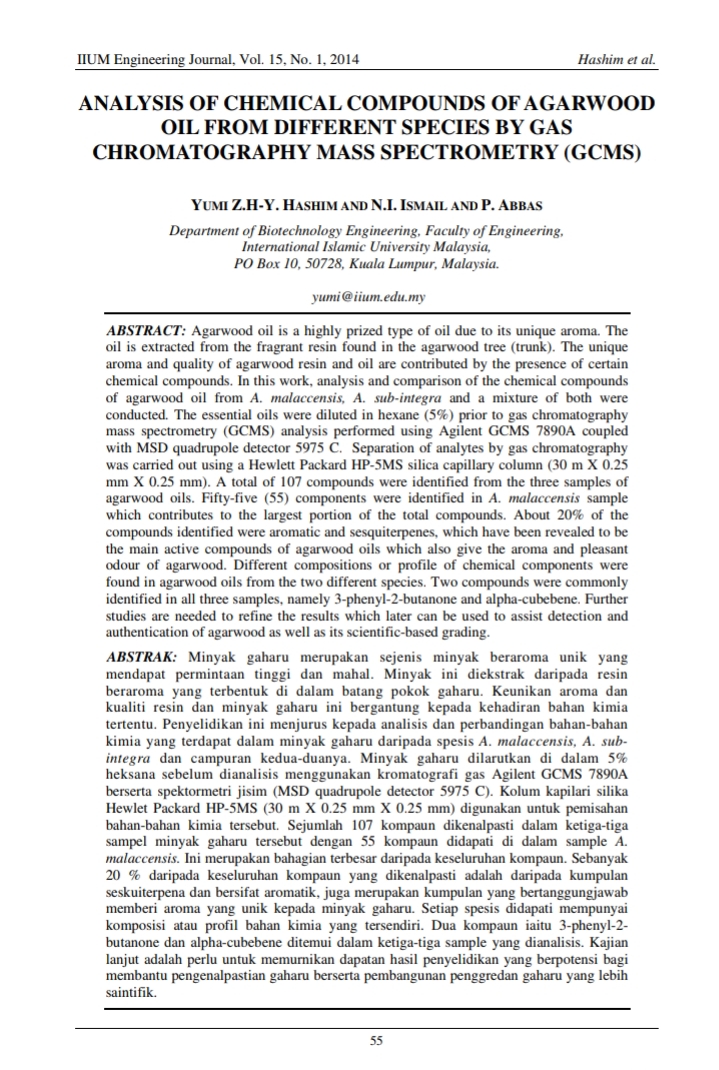
Judul : ANALYSIS OF CHEMICAL COMPOUNDS OF AGARWOOD OIL FROM DIFFERENT SPECIES BY GAS CHROMATOGRAPHY MASS SPECTROMETRY (GCMS)
Abstract :
Agarwood oil is a highly prized type of oil due to its unique aroma. The oil is extracted from the fragrant resin found in the agarwood tree (trunk). The unique aroma and quality of agarwood resin and oil are contributed by the presence of certain chemical compounds. In this work, analysis and comparison of the chemical compounds of agarwood oil from A. malaccensis, A. sub-integra and a mixture of both were conducted. The essential oils were diluted in hexane (5%) prior to gas chromatography mass spectrometry (GCMS) analysis performed using Agilent GCMS 7890A coupled with MSD quadrupole detector 5975 C. Separation of analytes by gas chromatography was carried out using a Hewlett Packard HP-5MS silica capillary column (30 m X 0.25 mm X 0.25 mm). A total of 107 compounds were identified from the three samples of agarwood oils. Fifty-five (55) components were identified in A. malaccensis sample which contributes to the largest portion of the total compounds. About 20% of the compounds identified were aromatic and sesquiterpenes, which have been revealed to be the main active compounds of agarwood oils which also give the aroma and pleasant odour of agarwood. Different compositions or profile of chemical components were found in agarwood oils from the two different species. Two compounds were commonly identified in all three samples, namely 3-phenyl-2-butanone and alpha-cubebene. Further studies are needed to refine the results which later can be used to assist detection and authentication of agarwood as well as its scientific-based grading.
1. Agfharinda Azwa 1914121003
2. Widia Putri Rahayu 1914121004
3. Aldhi Apriand. S 1914121040
Judul : ANALYSIS OF CHEMICAL COMPOUNDS OF AGARWOOD OIL FROM DIFFERENT SPECIES BY GAS CHROMATOGRAPHY MASS SPECTROMETRY (GCMS)
Abstract :
Agarwood oil is a highly prized type of oil due to its unique aroma. The oil is extracted from the fragrant resin found in the agarwood tree (trunk). The unique aroma and quality of agarwood resin and oil are contributed by the presence of certain chemical compounds. In this work, analysis and comparison of the chemical compounds of agarwood oil from A. malaccensis, A. sub-integra and a mixture of both were conducted. The essential oils were diluted in hexane (5%) prior to gas chromatography mass spectrometry (GCMS) analysis performed using Agilent GCMS 7890A coupled with MSD quadrupole detector 5975 C. Separation of analytes by gas chromatography was carried out using a Hewlett Packard HP-5MS silica capillary column (30 m X 0.25 mm X 0.25 mm). A total of 107 compounds were identified from the three samples of agarwood oils. Fifty-five (55) components were identified in A. malaccensis sample which contributes to the largest portion of the total compounds. About 20% of the compounds identified were aromatic and sesquiterpenes, which have been revealed to be the main active compounds of agarwood oils which also give the aroma and pleasant odour of agarwood. Different compositions or profile of chemical components were found in agarwood oils from the two different species. Two compounds were commonly identified in all three samples, namely 3-phenyl-2-butanone and alpha-cubebene. Further studies are needed to refine the results which later can be used to assist detection and authentication of agarwood as well as its scientific-based grading.
Kelompok 4
1. Sabila Azzahra 1914121032
2. Karimah 1954121001
Title of Journal:
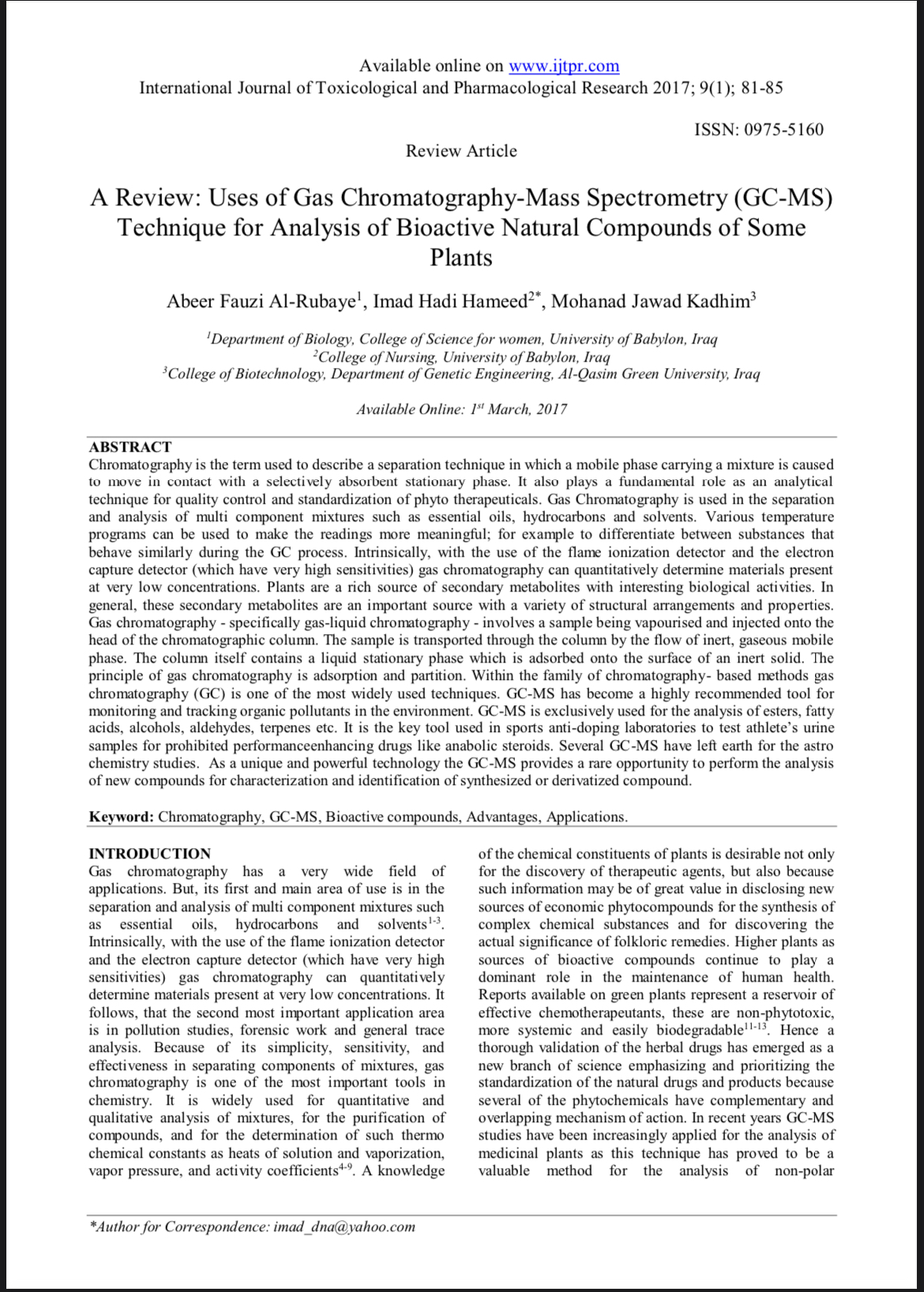
A Review: Uses of Gas Chromatography-Mass Spectrometry (GC-MS) Technique for Analysis of Bioactive Natural Compounds of Some Plants
Category of Journal:
International Journal of Toxicological and Pharmacological Research
Abstract:
Chromatography is the term used to describe a separation technique in which a mobile phase carrying a mixture is caused to move in contact with a selectively absorbent stationary phase. It also plays a fundamental role as an analytical technique for quality control and standardization of phyto therapeuticals. Gas Chromatography is used in the separation and analysis of multi component mixtures such as essential oils, hydrocarbons and solvents. Various temperature programs can be used to make the readings more meaningful; for example to differentiate between substances that behave similarly during the GC process. Intrinsically, with the use of the flame ionization detector and the electron capture detector (which have very high sensitivities) gas chromatography can quantitatively determine materials present at very low concentrations. Plants are a rich source of secondary metabolites with interesting biological activities. In general, these secondary metabolites are an important source with a variety of structural arrangements and properties. Gas chromatography - specifically gas-liquid chromatography - involves a sample being vapourised and injected onto the head of the chromatographic column. The sample is transported through the column by the flow of inert, gaseous mobile phase. The column itself contains a liquid stationary phase which is adsorbed onto the surface of an inert solid. The principle of gas chromatography is adsorption and partition. Within the family of chromatography- based methods gas chromatography (GC) is one of the most widely used techniques. GC-MS has become a highly recommended tool for monitoring and tracking organic pollutants in the environment. GC-MS is exclusively used for the analysis of esters, fatty acids, alcohols, aldehydes, terpenes etc. It is the key tool used in sports anti-doping laboratories to test athlete’s urine samples for prohibited performanceenhancing drugs like anabolic steroids. Several GC-MS have left earth for the astro chemistry studies. As a unique and powerful technology the GC-MS provides a rare opportunity to perform the analysis of new compounds for characterization and identification of synthesized or derivatized compound.
1. Sabila Azzahra 1914121032
2. Karimah 1954121001
Title of Journal:
A Review: Uses of Gas Chromatography-Mass Spectrometry (GC-MS) Technique for Analysis of Bioactive Natural Compounds of Some Plants
Category of Journal:
International Journal of Toxicological and Pharmacological Research
Abstract:
Chromatography is the term used to describe a separation technique in which a mobile phase carrying a mixture is caused to move in contact with a selectively absorbent stationary phase. It also plays a fundamental role as an analytical technique for quality control and standardization of phyto therapeuticals. Gas Chromatography is used in the separation and analysis of multi component mixtures such as essential oils, hydrocarbons and solvents. Various temperature programs can be used to make the readings more meaningful; for example to differentiate between substances that behave similarly during the GC process. Intrinsically, with the use of the flame ionization detector and the electron capture detector (which have very high sensitivities) gas chromatography can quantitatively determine materials present at very low concentrations. Plants are a rich source of secondary metabolites with interesting biological activities. In general, these secondary metabolites are an important source with a variety of structural arrangements and properties. Gas chromatography - specifically gas-liquid chromatography - involves a sample being vapourised and injected onto the head of the chromatographic column. The sample is transported through the column by the flow of inert, gaseous mobile phase. The column itself contains a liquid stationary phase which is adsorbed onto the surface of an inert solid. The principle of gas chromatography is adsorption and partition. Within the family of chromatography- based methods gas chromatography (GC) is one of the most widely used techniques. GC-MS has become a highly recommended tool for monitoring and tracking organic pollutants in the environment. GC-MS is exclusively used for the analysis of esters, fatty acids, alcohols, aldehydes, terpenes etc. It is the key tool used in sports anti-doping laboratories to test athlete’s urine samples for prohibited performanceenhancing drugs like anabolic steroids. Several GC-MS have left earth for the astro chemistry studies. As a unique and powerful technology the GC-MS provides a rare opportunity to perform the analysis of new compounds for characterization and identification of synthesized or derivatized compound.
Kelompok 1
1. Ajeng Windi Astuti 1914121001
2. Widi Riski Pebianti 1914121051
Judul : Biochemical analysis of Origanum vulgare seeds by fourier-transform infrared (FT-IR) spectroscopy and gas chromatography-mass spectrometry (GC-MS)
Abstract : Medicinal plants are potential sources of natural compounds with biological activities, and therefore attract the attention of researchers worldwide. The objective of this research is to determine the chemical composition of methanolic seed extract. The phytochemical compound screened by spectroscopy and gas chromatography-mass spectrometry (GC-MS) method. Sixteen bioactive phytochemical compounds were identified in the methanolic extract of Origanum vulgare. The identification of phytochemical compounds is based on the peak area, retention time molecular weight, molecular formula, MS Fragment- ions and pharmacological actions. GC-MS analysis of O. vulgare revealed the existence of the 1,7-Dioxaspiro[5,5]undec-2-ene, 2,4-Dihydroxy-2,5-dimethyl-39(2H)-furan3-one, 2,4-Difurobenzene, 1-benzyloxy, α-D Glucopyranoside, O-α- Glucopyranosyl, 4-Hexenal, 6-hydroxy-4-methyl,dimethyl acetal, acetate, 4H-pyran-4-one,2,3,-dihydro-3,5-dihydroxy-6-methyl, Benzofuran, 4-Amino-1,5-pentandioic acid, 2-Methoxy-4-vinylphenol, d-Mannose, 7-Isopropyl-10-methyl1-oxo-1,5-dithia-spiro[5,5]undecane-2-carboxy, Phytol, Cis-Vaccenic acid, N MethylNbenzyltetradecanamine, 3,8,8-Trimethoxy-3-piperidyl-2,2-binaphthalene-1,1,4,4-tetrone, and 17-(1,5- Dimethylhexyl)10,13-dimethyl. The FTIR analysis of O. vulgare seeds proved the presence of alkenes, aliphatic fluoro compounds, alcohols, ethers, carboxlic acids, esters and hydrogen bonded alcohols, phenols.
1. Ajeng Windi Astuti 1914121001
2. Widi Riski Pebianti 1914121051
Judul : Biochemical analysis of Origanum vulgare seeds by fourier-transform infrared (FT-IR) spectroscopy and gas chromatography-mass spectrometry (GC-MS)
Abstract : Medicinal plants are potential sources of natural compounds with biological activities, and therefore attract the attention of researchers worldwide. The objective of this research is to determine the chemical composition of methanolic seed extract. The phytochemical compound screened by spectroscopy and gas chromatography-mass spectrometry (GC-MS) method. Sixteen bioactive phytochemical compounds were identified in the methanolic extract of Origanum vulgare. The identification of phytochemical compounds is based on the peak area, retention time molecular weight, molecular formula, MS Fragment- ions and pharmacological actions. GC-MS analysis of O. vulgare revealed the existence of the 1,7-Dioxaspiro[5,5]undec-2-ene, 2,4-Dihydroxy-2,5-dimethyl-39(2H)-furan3-one, 2,4-Difurobenzene, 1-benzyloxy, α-D Glucopyranoside, O-α- Glucopyranosyl, 4-Hexenal, 6-hydroxy-4-methyl,dimethyl acetal, acetate, 4H-pyran-4-one,2,3,-dihydro-3,5-dihydroxy-6-methyl, Benzofuran, 4-Amino-1,5-pentandioic acid, 2-Methoxy-4-vinylphenol, d-Mannose, 7-Isopropyl-10-methyl1-oxo-1,5-dithia-spiro[5,5]undecane-2-carboxy, Phytol, Cis-Vaccenic acid, N MethylNbenzyltetradecanamine, 3,8,8-Trimethoxy-3-piperidyl-2,2-binaphthalene-1,1,4,4-tetrone, and 17-(1,5- Dimethylhexyl)10,13-dimethyl. The FTIR analysis of O. vulgare seeds proved the presence of alkenes, aliphatic fluoro compounds, alcohols, ethers, carboxlic acids, esters and hydrogen bonded alcohols, phenols.