Silahkan kumpulkan tugas sesuai dengan perintah
Nama kelompok:
Agfharinda Azwa 1914121003
Widia Putri Rahayu 1914121004
Aldhi Apriand.S 1914121040
Judul: Simultaneous determination of catechins, caffeine and gallicacids in green, Oolong, black and pu-erh teas using HPLC with a photodiode array detector
Agfharinda Azwa 1914121003
Widia Putri Rahayu 1914121004
Aldhi Apriand.S 1914121040
Judul: Simultaneous determination of catechins, caffeine and gallicacids in green, Oolong, black and pu-erh teas using HPLC with a photodiode array detector
Jurnal :Talanta
Abstrak:
A simple and fast HPLC method using a photodiode array detector was developed for simultaneous determination of four major catechins, gallic acid and caffeine. After multiple extractions with aqueous methanol and acidic methanol solutions, tea extract was separated within 20 min using a methanol– acetate–water buffer gradient elutionsystem on a C18 column. The sample extraction data demonstrated that the single extraction used in the previous studies with aqueous acetonitrile or methanol is not sufficient; the multiple extraction procedure is essential for the quantitative analysis of catechins, phenolic acids and caffeine in teas. Several green, Oolong, black and pu-erh teas were successfully analyzed by this method. The analytical results obtained indicated that green teas contain higher content of catechins [(−)-epigallocatechin gallate, (−)-epigallocatechin, (−)-epicatechin gallate, and (−)-epicate-chin] than both Oolong, pu-erh and black teas because fermentation process during the tea manufacturing reduced the levels of catechins significantly. The fermentation process also remarkably elevated the levels of gallic acid in full-fermented pu-erh and black teas. Another interesting finding is the low level of caffeine in Oolong teas, especially in Fujian Oolong tea. © 2002 Elsevier Science B.V. All rights reserved.
Abstrak:
A simple and fast HPLC method using a photodiode array detector was developed for simultaneous determination of four major catechins, gallic acid and caffeine. After multiple extractions with aqueous methanol and acidic methanol solutions, tea extract was separated within 20 min using a methanol– acetate–water buffer gradient elutionsystem on a C18 column. The sample extraction data demonstrated that the single extraction used in the previous studies with aqueous acetonitrile or methanol is not sufficient; the multiple extraction procedure is essential for the quantitative analysis of catechins, phenolic acids and caffeine in teas. Several green, Oolong, black and pu-erh teas were successfully analyzed by this method. The analytical results obtained indicated that green teas contain higher content of catechins [(−)-epigallocatechin gallate, (−)-epigallocatechin, (−)-epicatechin gallate, and (−)-epicate-chin] than both Oolong, pu-erh and black teas because fermentation process during the tea manufacturing reduced the levels of catechins significantly. The fermentation process also remarkably elevated the levels of gallic acid in full-fermented pu-erh and black teas. Another interesting finding is the low level of caffeine in Oolong teas, especially in Fujian Oolong tea. © 2002 Elsevier Science B.V. All rights reserved.

Nama:
1. Anggun Sari (1914121005)
2. Ulivia Alfina Zahra (1914121011)
Judul: A decade of HPLC-MS/MS in the
routine clinical laboratory -Goals forfurther developments
Jurnal:
Clinical Biochemistry
Abstract:
During the past decade, tandem mass spectrometry hyphenated to liquid chromatography separation systems (HPLC–MS/MS) has developed to an important technology in clinical chemistry — not only for research purposes but also for routine use. At present, most important application fields are target analyses in therapeutic drug monitoring (TDM) and metabolic disorders diagnosis. The essential strengths of HPLC–MS/MS include potentially high analytical specificity, wide range of applicability to small and large molecules, capability of multi- and mega-parametric tests, and the opportunity to develop powerful assays with a high degree of flexibility within a short time frame. The technique has overcome important limitations of GC–MS and is characterized by short analytical runtimes, applicability to thermo labile, polar and large molecules, and straightforward sample preparation. However, implementation of HPLC–MS/MS assays still requires substantial expertise and know-how. At the present, its application is limited to a rather small number of clinical routine laboratories. Nonetheless, HPLC–MS/MS has the potential to be further developed to a commonly applied high-throughput technique in clinical chemistry, complementary to present standard techniques as photometry and ligand binding methods. This review intends to characterize working characteristics of present day HPLC–MS/MS instrumentations used in clinical routine laboratories. Limitations of currently available systems and applications will be critically discussed. Required instrument improvements supporting the successful spreading of HPLC–MS/MS in laboratory medicine within the next decade will be outlined.
routine clinical laboratory -Goals forfurther developments
Jurnal:
Clinical Biochemistry
Abstract:
During the past decade, tandem mass spectrometry hyphenated to liquid chromatography separation systems (HPLC–MS/MS) has developed to an important technology in clinical chemistry — not only for research purposes but also for routine use. At present, most important application fields are target analyses in therapeutic drug monitoring (TDM) and metabolic disorders diagnosis. The essential strengths of HPLC–MS/MS include potentially high analytical specificity, wide range of applicability to small and large molecules, capability of multi- and mega-parametric tests, and the opportunity to develop powerful assays with a high degree of flexibility within a short time frame. The technique has overcome important limitations of GC–MS and is characterized by short analytical runtimes, applicability to thermo labile, polar and large molecules, and straightforward sample preparation. However, implementation of HPLC–MS/MS assays still requires substantial expertise and know-how. At the present, its application is limited to a rather small number of clinical routine laboratories. Nonetheless, HPLC–MS/MS has the potential to be further developed to a commonly applied high-throughput technique in clinical chemistry, complementary to present standard techniques as photometry and ligand binding methods. This review intends to characterize working characteristics of present day HPLC–MS/MS instrumentations used in clinical routine laboratories. Limitations of currently available systems and applications will be critically discussed. Required instrument improvements supporting the successful spreading of HPLC–MS/MS in laboratory medicine within the next decade will be outlined.

Kelompok :
1. Ajeng Windi Astuti (1814121001)
2. Widi Riski Pebianti (1914121051)
Judul :
RP-HPLC determination of water-soluble vitamins in honey
Jurnal:
Talanta
Abstrak:
The assessment and validation of reliable analytical methods for the determination of vitamins in sugarbased matrices (e.g. honey) are still scarcely explored fields of research. This study proposes and fully validates a simple and fast RP-HPLC method for the simultaneous determination of five water-soluble vitamins (vitamin B2, riboflavin; vitamin B3, nicotinic acid; vitamin B5, pantothenic acid; vitamin B9, folic acid; and vitamin C, ascorbic acid) in honey. The method provides low detection and quantification limits, very good linearity in a large concentration interval, very good precision, and the absence of any bias. It has been successfully applied to 28 honey samples (mainly from Sardinia, Italy) of 12 different botanical origins. While the overall amount of the analytes in the samples is quite low (always below 40 mg kg−1), we have observed a marked dependence of some of their concentrations (i.e. vitamin B3 and vitamin B5) and the botanical origin of the honey. This insight might lead to important characterization features for this food item.
1. Ajeng Windi Astuti (1814121001)
2. Widi Riski Pebianti (1914121051)
Judul :
RP-HPLC determination of water-soluble vitamins in honey
Jurnal:
Talanta
Abstrak:
The assessment and validation of reliable analytical methods for the determination of vitamins in sugarbased matrices (e.g. honey) are still scarcely explored fields of research. This study proposes and fully validates a simple and fast RP-HPLC method for the simultaneous determination of five water-soluble vitamins (vitamin B2, riboflavin; vitamin B3, nicotinic acid; vitamin B5, pantothenic acid; vitamin B9, folic acid; and vitamin C, ascorbic acid) in honey. The method provides low detection and quantification limits, very good linearity in a large concentration interval, very good precision, and the absence of any bias. It has been successfully applied to 28 honey samples (mainly from Sardinia, Italy) of 12 different botanical origins. While the overall amount of the analytes in the samples is quite low (always below 40 mg kg−1), we have observed a marked dependence of some of their concentrations (i.e. vitamin B3 and vitamin B5) and the botanical origin of the honey. This insight might lead to important characterization features for this food item.

1. Sabila Azzahra 1914121032
2. Karimah 1954121001
Title of Journal:
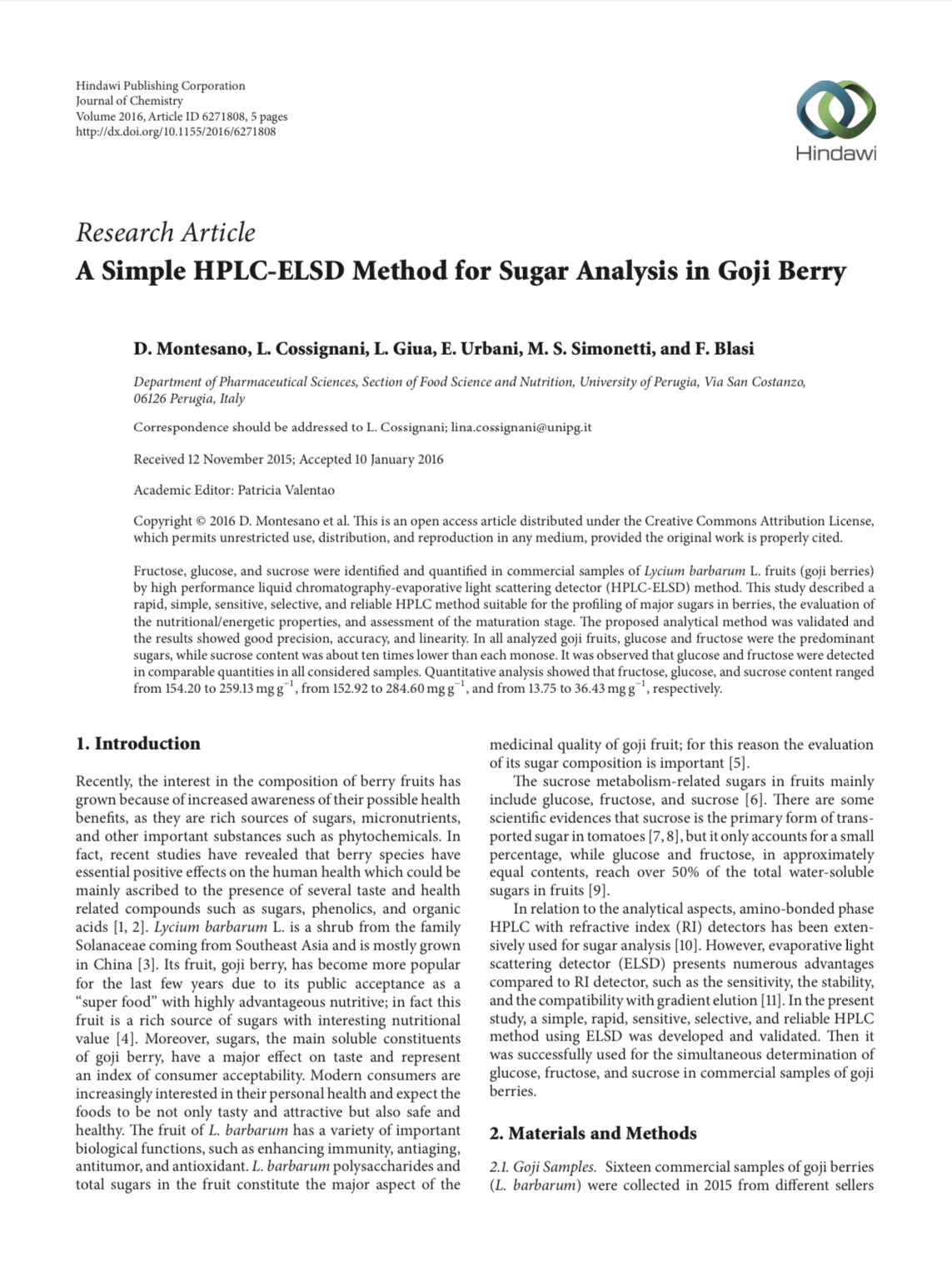
A Simple HPLC-ELSD Method for Sugar Analysis in Goji Berry
Category of Journal:
Journal of Chemistry
Abstract:
Fructose, glucose, and sucrose were identified and quantified in commercial samples of Lycium barbarum L. fruits (goji berries) by high performance liquid chromatography-evaporative light scattering detector (HPLC-ELSD) method. This study described a rapid, simple, sensitive, selective, and reliable HPLC method suitable for the profiling of major sugars in berries, the evaluation of the nutritional/energetic properties, and assessment of the maturation stage. The proposed analytical method was validated and the results showed good precision, accuracy, and linearity. In all analyzed goji fruits, glucose and fructose were the predominant sugars, while sucrose content was about ten times lower than each monose. It was observed that glucose and fructose were detected in comparable quantities in all considered samples. Quantitative analysis showed that fructose, glucose, and sucrose content ranged from 154.20 to 259.13 mg g−1, from 152.92 to 284.60 mg g−1, and from 13.75 to 36.43 mg g−1, respectively.
2. Karimah 1954121001
Title of Journal:
A Simple HPLC-ELSD Method for Sugar Analysis in Goji Berry
Category of Journal:
Journal of Chemistry
Abstract:
Fructose, glucose, and sucrose were identified and quantified in commercial samples of Lycium barbarum L. fruits (goji berries) by high performance liquid chromatography-evaporative light scattering detector (HPLC-ELSD) method. This study described a rapid, simple, sensitive, selective, and reliable HPLC method suitable for the profiling of major sugars in berries, the evaluation of the nutritional/energetic properties, and assessment of the maturation stage. The proposed analytical method was validated and the results showed good precision, accuracy, and linearity. In all analyzed goji fruits, glucose and fructose were the predominant sugars, while sucrose content was about ten times lower than each monose. It was observed that glucose and fructose were detected in comparable quantities in all considered samples. Quantitative analysis showed that fructose, glucose, and sucrose content ranged from 154.20 to 259.13 mg g−1, from 152.92 to 284.60 mg g−1, and from 13.75 to 36.43 mg g−1, respectively.